


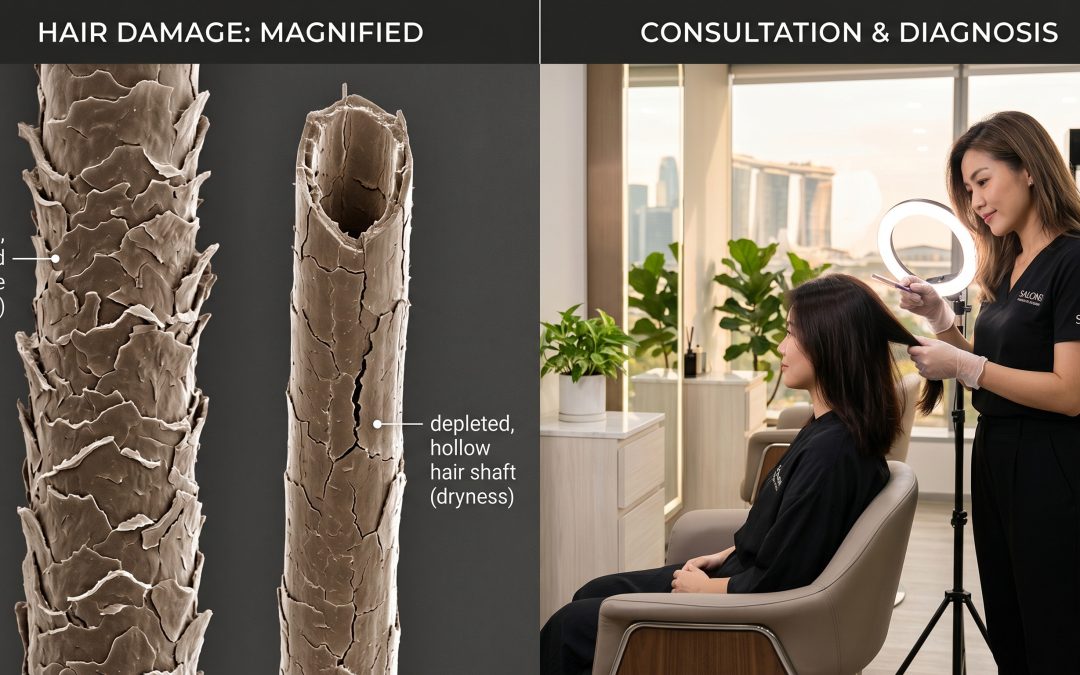
“My hair is so dry and frizzy.” It is a phrase we hear every single day, but from a biological standpoint, grouping these two issues together is a major mistake. Frizz and dryness are entirely different problems requiring completely distinct chemical solutions. Frizz is a structural issue occurring on the outside of the hair, while dryness is a nutritional deficit on the inside. Misdiagnosing your own hair leads to booking the wrong services, wasting your hard-earned money, and feeling frustrated when your hair doesn’t actually improve. As a premier hairdressing salon singapore, SalonPlus believes in treating the biological root cause, not just the symptoms. Here is the scientific breakdown of why your hair is misbehaving and how we properly diagnose it before a single drop of product touches your head.
1. The Biology of Frizz: The Lifted Cuticle
The Transformation: Frizz happens when the outermost layer of your hair (the cuticle) resembles a rough, open pinecone rather than a smooth, closed shingle roof. It desperately needs structural sealing, not just moisture.
- Service Breakdown: When the cuticle is open, the hair reaches out into the humid air to grab ambient moisture, causing the strand to swell, bend, and frizz [2]. Applying a basic hydrating mask won’t fix this. To resolve frizz, we prescribe an anti frizz hair treatment (like a keratin smoothing service). These treatments use specialized proteins and heat to physically fill the microscopic gaps in the cuticle and seal it tightly shut, creating a smooth, hydrophobic (water-repellent) shield.
- Styling Trick: Always point your hairdryer nozzle strictly downwards when drying. Blowing air up the hair shaft forces the cuticle open, creating mechanical frizz even on perfectly healthy, well-moisturized hair.
- Tip for styling in SG weather: Because Singapore’s high humidity is constantly trying to pry your cuticle open [3], a silicone-based or anti-humectant smoothing serum is mandatory. It acts like an invisible raincoat, stopping water vapor from entering the hair shaft.
- What to Expect from Maintenance: A professional anti-frizz smoothing treatment typically lasts between 3 to 6 months. You will need to use sulfate-free shampoos at home to prevent prematurely stripping the protective sealant from the hair.
2. The Biology of Dryness: The Depleted Cortex
The Transformation: Dry hair lacks internal water, lipids, and essential oils inside the core of the hair (the cortex). The hair may actually lay flat with no frizz, but it feels rough, snaps easily, and lacks reflective shine. It needs deep, penetrative hydration.
- Service Breakdown: Applying a surface-level cuticle sealant to bone-dry hair is like putting a band-aid on dehydration—it simply locks the dryness inside. Instead, we prescribe a deeply penetrative hair treatment packed with humectants, ceramides, and amino acids [4]. We utilize salon-grade micro-mist steamers to gently open the cuticle, push this intense moisture deep into the cortex, and then lock it inside to restore elasticity and softness.
- Styling Trick: Practice product layering. Apply a water-based leave-in conditioner first to provide hydration to the cortex, and follow it immediately with a lightweight hair oil to seal the cuticle and trap that moisture inside.
- Tip for styling in SG weather: The intense tropical sun and heavy indoor air-conditioning rapidly evaporate your hair’s internal moisture. Substitute your regular conditioner for a rich hydration mask once a week to continually replenish the water your hair loses to the environment.
- What to Expect from Maintenance: Internal hydration is an ongoing process. Expect to visit the salon for a deep-conditioning moisture reset every 4 to 6 weeks, paired with a strict at-home moisturizing routine.
3. The SalonPlus Diagnostic Protocol
The Transformation: Often, clients suffer from “combination hair”—hair that is both severely dry and structurally frizzy. Treating them in the wrong order is a recipe for disaster.
- Service Breakdown: At the leading hair salon singapore, we never guess. We perform a physical stretch test (checking for elasticity, which indicates internal moisture levels) and a porosity test (checking how fast water absorbs, which indicates cuticle damage) [1]. If your hair is severely dry, we must rebuild the internal moisture before we seal the cuticle with an anti-frizz treatment. Sealing dehydrated hair will cause it to become brittle and snap off later.
- Styling Trick: Listen to your hair’s drying time. If your hair takes hours to air-dry, it is highly porous with an open cuticle (frizz-prone). If it dries almost instantly but feels like straw, it lacks internal moisture (dryness).
- Tip for styling in Singapore’s climate: Do not overload your hair with thick, heavy oils trying to fix frizz. If your hair is merely dry, heavy oils will just weigh it down, making it look flat and greasy in the humid city air without actually providing internal hydration.
- What to Expect for Maintenance: A customized roadmap. We map out exactly which treatments you need and in what chronological order, ensuring every dollar you invest actively rehabilitates your hair over the long term.
Ready to Stop Guessing?
You wouldn’t take medication without a doctor’s diagnosis, and your hair should be treated with the same scientific care. Stop wasting money on treatments that don’t target your actual biological hair issues.
Are you ready to find out what your hair really needs? Book a diagnostic consultation at SalonPlus today. We will assess your cuticle health, measure your internal moisture, and prescribe the exact, tailored treatments needed to bring your hair back to life.
References
[1] American Academy of Dermatology Association (AAD). (2026). How to stop damaging your hair. (Clinical guidelines on diagnosing hair breakage, assessing elasticity, and understanding moisture deficits).
[2] Wikipedia. (2026). Hair. (General reference outlining the anatomical structure of the hair shaft, detailing the difference between the outer cuticle and the inner cortex).
[3] National Environment Agency (NEA), Singapore. (2026). Climate of Singapore. (Meteorological data detailing the high ambient humidity that actively forces the hair cuticle open).
[4] International Journal of Trichology. (2026). Hair Cosmetics: An Overview. (Scientific source explaining the differing chemical mechanisms of penetrative cortex hydrators versus surface-level cuticle sealants).