


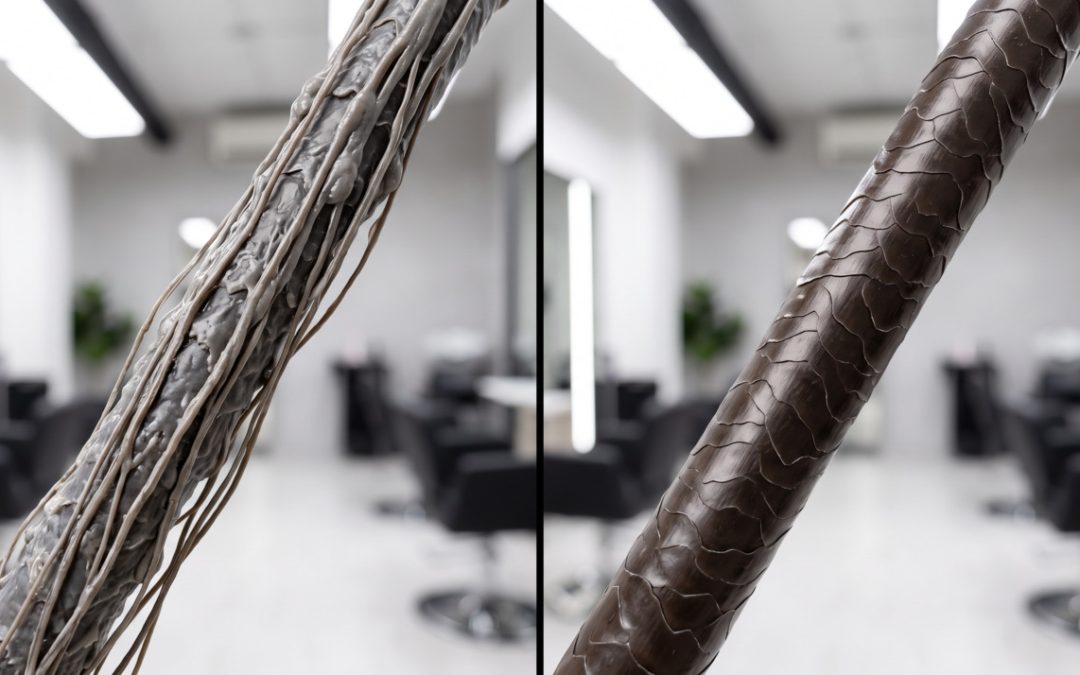
In Singapore’s relentless humidity, frizz is public enemy number one. It is incredibly tempting to reach for a quick fix—usually a cheap, heavily fragranced drugstore hair serum or “oil.” You apply it, and instantly, your hair feels silky and looks glossy. But within a few weeks, your hair becomes chronically dry, brittle, and somehow even frizzier than before. You are caught in the silicone trap.
Most commercial hair serums aren’t actually repairing your hair; they are simply covering up the damage with synthetic plastics. Continuing to mask the problem with cheap DIY fixes will only lead to severe dehydration and breakage. To truly conquer frizz and elevate your hair health, you need to understand the chemical difference between surface-level illusions and deep molecular repair.
1. The Silicone Illusion: Makeup for Your Hair
The Transformation: Many popular drugstore “argan oils” or “smoothing serums” are actually up to 90% synthetic silicones (look for ingredients ending in “-cone,” like dimethicone). They do not heal your hair; they simply shrink-wrap it.
- Service Breakdown: When you apply a cheap silicone serum, it forms a thin, waterproof barrier around the hair shaft. This immediately smooths down the rough cuticle scales, giving you instant “slip” and shine. However, this is purely cosmetic—like applying heavy foundation over a dry skin patch without actually moisturizing it [4]. The underlying structural damage remains completely untreated.
- Styling Trick: Learn to read your ingredient labels. If a silicone derivative is listed in the top three ingredients of your hair oil, it is a synthetic sealant, not a nourishing hydrator.
- Tip for styling in SG weather: In Singapore’s sweltering heat, thick silicone serums trap scalp sweat and atmospheric heat against your hair. This creates a heavy, greasy aesthetic by midday that separates your hair into unappealing, stringy clumps.
- What to Expect from Maintenance: Continuing to use heavy silicones forces you into a vicious cycle: you must use harsh clarifying shampoos to strip the plastic coating, which further dehydrates the hair, forcing you to apply more silicone to hide the damage.
2. The Dehydration Cycle: Suffocating the Cuticle
The Transformation: Because silicone is intensely hydrophobic (water-repelling), the seal it creates works both ways. While it temporarily keeps atmospheric humidity out, it completely blocks real moisture from getting in.
- Service Breakdown: Over time, the internal core of your hair (the cortex) suffocates beneath this plastic-like coating. No amount of expensive conditioner can penetrate the silicone shield [1]. The cortex dries out, causing the hair to lose its natural elasticity. When hair loses elasticity, it snaps. This mechanical breakage creates hundreds of short, frayed split ends that stick straight up, resulting in a permanent “frizz halo” that no amount of serum can tame.
- Styling Trick: If your hair feels slick when wet but turns stiff, rough, and straw-like the moment it dries, you are suffering from severe silicone buildup. Stop applying oil immediately.
- Tip for styling in Singapore’s climate: A suffocated, dehydrated hair shaft is inherently unstable. The moment the silicone barrier inevitably wears thin in the tropical weather, the parched hair aggressively absorbs ambient humidity, swelling the cuticle and causing catastrophic frizz [3].
- What to Expect for Maintenance: To break the cycle, you must undergo a professional detox to chemically strip the synthetic buildup safely without compromising your hair’s natural lipid barrier.
3. Molecular Repair: The True Anti-Frizz Solution
The Transformation: If your hair is crying out for real hydration, covering it in plastic is the worst thing you can do. You need active ingredients small enough to bypass the cuticle and heal the cortex.
- Service Breakdown: At a premium salon, we completely bypass cheap synthetic band-aids. Instead, we prescribe an advanced, molecular hair treatment. These clinical-grade formulas utilize bio-peptides, amino acids, and low-molecular-weight humectants that dive deep into the hair shaft. Rather than coating the surface, an authentic anti frizz hair treatment actively seeks out and reconnects broken disulfide bonds and keratin chains [2].
- Styling Trick: Switch to water-soluble styling products and pure, cold-pressed botanical oils (like squalane or jojoba) that naturally penetrate the cuticle rather than suffocating it.
- Tip for styling in SG weather: Hair that is organically hydrated from the inside out does not frizz. When the inner cortex is packed with structural moisture, it has no reason to reach out and absorb the ambient humidity in the Singapore air, ensuring a sleek, natural finish all day long.
- What to Expect for Maintenance: A professional molecular repair treatment fundamentally alters your hair’s health. You will notice lasting softness and resilience for 6 to 8 weeks, drastically reducing your need for daily styling products.
Ready to Cure Your Frizz at the Source?
Stop wasting your money on drugstore illusions that ultimately destroy your hair’s internal moisture. It is time to strip away the synthetic buildup and invest in the biological health of your strands with professional, molecular science.
Are you ready to experience how weightless, soft, and naturally frizz-free your real hair can be? Book a diagnostic consultation and custom repair treatment at SalonPlus today. Our master stylists will safely detox your hair and infuse your strands with the exact structural repair they have been starving for.
References
[1] American Academy of Dermatology Association (AAD). (2026). How to stop damaging your hair. (Clinical guidelines detailing the importance of removing synthetic barrier buildup to allow for proper moisture absorption and prevent cuticle snapping).
[2] Wikipedia. (2026). Keratin. (General reference outlining the protein structure of human hair and the mechanics of internal disulfide bond repair versus external synthetic coating).
[3] National Environment Agency (NEA), Singapore. (2026). Climate of Singapore. (Meteorological data detailing local ambient humidity and its osmotic effect on dehydrated, highly porous hair cuticles).
[4] International Journal of Trichology. (2026). Hair Cosmetics: An Overview. (Scientific literature explaining the chemical properties of dimethicone and other silicone-based polymers, highlighting their hydrophobic effects and potential for cumulative buildup).