


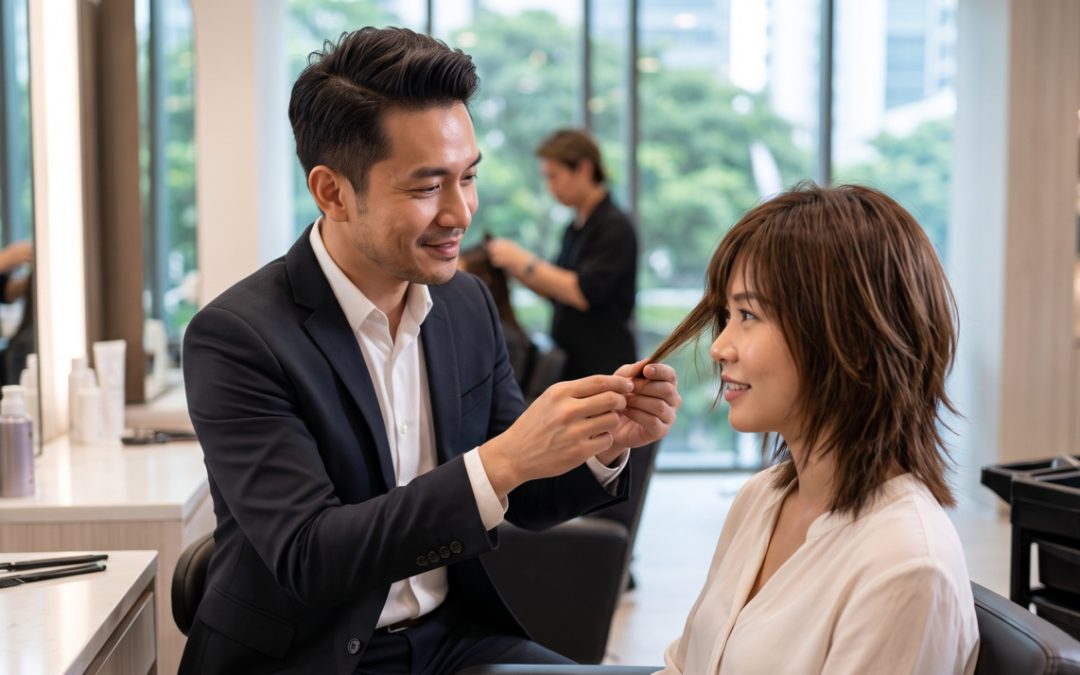
Experiencing a bad haircut is more than just a cosmetic inconvenience; it can severely impact your daily confidence and cause intense “hair anxiety.” When a cut goes wrong at another salon, many clients feel too intimidated to speak up or fear they will insult the new stylist when asking for a fix. However, suffering in silence while wearing a hat for three months is not the solution. As an expert hairstylist orchard, we see botched haircuts every single week. We view them not as a point of judgment, but as a structural puzzle waiting to be solved. To get the exact fix you need, it helps to understand the vocabulary of hair geometry. Here is your guide to communicating effectively, decoding what went wrong, and experiencing the relief of a truly professional corrective consultation.
1. Decoding Bulk: “Too Heavy” vs. “Too Thin”
The Transformation: Often, a haircut looks “wrong” not because of the length, but because of how the internal weight is distributed. A poorly balanced cut can leave you looking like a mushroom (too heavy) or feeling like you have stringy, fragile ends (too thin).
- Service Breakdown: During our non-judgmental consultation, we audit the “weight line” of your hair. If you tell us, “It feels too bulky at the bottom,” we know the previous stylist failed to texturize the perimeter. We will use precision slide-cutting to remove internal weight without sacrificing your length [2]. If you say, “My ends feel stringy and hollow,” we know thinning shears were overused. The corrective action here is establishing a new, blunt baseline to restore structural density.
- Styling Trick: If you are dealing with overly thinned, stringy ends while waiting for your corrective cut, use a volumizing mousse at the roots and a round brush to bend the ends inward. This creates an optical illusion of thickness.
- Tip for styling in SG weather: In Singapore, over-thinned hair is a disaster. High humidity penetrates the weakened, thinned-out strands instantly, causing uncontrollable frizz and static [3]. A corrective blunt cut instantly seals the baseline, making the hair significantly more resistant to tropical moisture.
- What to Expect from Maintenance: Correcting a severely thinned-out haircut takes time. Expect to need frequent “dusting” trims every 4 to 6 weeks to slowly chop off the stringy pieces as your healthy, dense hair grows down.
2. Decoding Layers: “Choppy” vs. “Blended”
The Transformation: The most common corrective request we receive involves botched layers. When layers are disconnected, they look like harsh, visible “steps” in the hair rather than a seamless cascade.
- Service Breakdown: If you hate your layers, tell your hairstylist far east plaza, “My layers look choppy and don’t blend.” This exact phrasing tells us the elevation angles used previously were geometrically incorrect. To fix this, we perform a structural blending cut. We cross-check the hair horizontally and vertically, softening the harsh corners and integrating the short top layers into the longer bottom layers so the hair moves as a single, fluid unit [4].
- Styling Trick: To hide harsh, choppy layers temporarily, avoid wearing your hair bone-straight, which highlights every uneven cut. Instead, use a curling wand to create loose waves; the texture and movement will camouflage the disconnected “steps.”
- Tip for styling in SG weather: Choppy layers expose multiple different lengths of hair cuticles to the hot, humid air, causing the hair to puff outward in multiple directions [3]. Blending the layers correctly brings the cuticles back into alignment, heavily reducing the dreaded midday frizz cloud.
- What to Expect for Maintenance: Depending on how short the shortest layer is, a complete blending correction may require sacrificing an inch or two of overall length. Your stylist will map out a long-term hair makeover singapore plan to grow the layers out evenly over the next 3 to 6 months.
3. The Non-Judgmental Consultation: Your Safe Space
The Transformation: The most important step in fixing a bad haircut is establishing trust. You need a stylist who listens to your trauma without defensiveness and offers a clear, realistic roadmap to recovery.
- Service Breakdown: At our premium hair salon orchard singapore, we pride ourselves on a culture of deep empathy. Our consultation starts with you showing us exactly where the hair misbehaves. We will physically examine your growth patterns, cowlicks, and hair density. We will never insult you for a previous stylist’s mistake; instead, we act as hair architects, mapping out the precise angles and techniques required to salvage the shape and restore your aesthetic identity [1].
- Styling Trick: When coming in for a corrective cut, arrive with your hair styled the way you normally wear it on a daily basis. Do not tie it in a tight bun. Seeing how the bad cut naturally falls and misbehaves gives us the exact visual clues we need to fix it.
- Tip for styling in Singapore’s climate: Hair anxiety often leads to over-styling and heat damage as clients frantically try to flat-iron away a bad cut. A masterfully corrected haircut is designed to air-dry beautifully, saving your hair from thermal frying in an already harsh environment.
- What to Expect for Maintenance: You will leave the salon with a sense of immense relief. We will provide a strict timeline for your next reshaping appointments, ensuring your hair gracefully transitions from a botched nightmare into your dream style.
Ready to Fix Your Hair and Reclaim Your Confidence?
You do not have to live with a haircut you hate. Hair anxiety is cured by professional intervention, geometric precision, and a stylist who truly listens to your concerns.
Are you hiding a bad haircut under a claw clip? Book a corrective consultation at SalonPlus today. Our empathetic master stylists will carefully analyze your current cut, speak your language, and expertly reconstruct your style so you can look in the mirror and smile again.
References
[1] American Academy of Dermatology Association (AAD). (2026). Tips for healthy hair. (Clinical guidelines emphasizing the psychological impact of hair aesthetics and the importance of healthy structural maintenance).
[2] Wikipedia. (2026). Layered hair. (General reference outlining the geometric principles of weight removal, elevation angles, and the difference between point-cutting and thinning).
[3] National Environment Agency (NEA), Singapore. (2026). Climate of Singapore. (Meteorological data detailing the high ambient humidity that exacerbates the visual flaws of over-thinned and choppy haircuts).
[4] International Journal of Trichology. (2026). Optical Illusions in Hair Cutting. (Scientific literature detailing the mechanics of visual blending, light reflection on cuticles, and structural balance in hair cutting).