


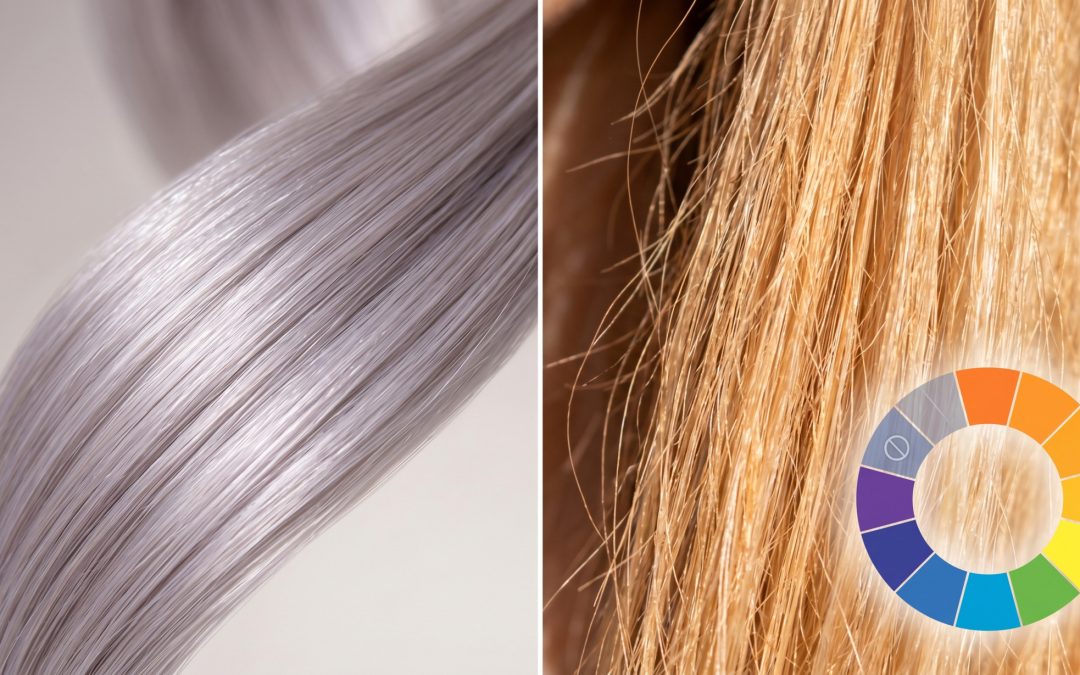
It is the most frustrating cycle in haircare: you spend hours in the salon achieving the perfect, cool-toned ash blonde, only to watch it fade into a glaring, brassy orange within a matter of weeks. The immediate reaction is to blame the stylist or the brand of bleach used. However, the true culprit is a combination of fundamental color theory and environmental physics. In Singapore, you aren’t just fighting fading; you are fighting active photo-oxidation caused by the sun. To keep your hair looking wealthy and intentional, you must understand the microscopic battle happening inside your hair cuticle. Here is the biological breakdown of why your hair turns orange, and how expert colorists formulate solutions to stop it.
1. The Raw Canvas: Exposing the Underlying Warmth
The Transformation: To understand why your hair turns orange, you must understand what happens when it is bleached. Asian hair naturally contains dense concentrations of eumelanin (dark pigment) and pheomelanin (red/yellow pigment).
- Service Breakdown: When bleach is applied, it violently oxidizes and dissolves these natural pigments [2]. However, the dark eumelanin breaks down easily, while the red/orange pheomelanin is incredibly stubborn. When the bleach is washed out, your raw, lightened hair is naturally yellow or bright orange. To create an “ash” blonde, the stylist must deposit a cool-toned toner (packed with blue and purple dye molecules) over this raw orange canvas to neutralize the warmth.
- Styling Trick: Heat physically opens the hair cuticle, allowing that carefully deposited toner to slip out and wash down the drain. Always rinse your freshly colored hair with cool or lukewarm water to keep the cuticle tightly sealed.
- Tip for styling in SG weather: Singapore’s humidity causes the hair shaft to swell naturally [3]. When the hair swells, the cuticles lift, accelerating the loss of your expensive cool-toned toner. Using an anti-humectant serum before leaving the house is mandatory to keep the hair sealed.
- What to Expect from Maintenance: Because toner is essentially just a “cool coat of paint” over an orange canvas, it is inherently temporary. You must commit to professional glossing treatments long after the initial bleaching session.
2. Photo-Oxidation: Why the Blue Molecules Die First
The Transformation: Now that the cool-toned dye is in your hair, the environment begins to attack it. The specific reason your hair turns orange is due to the varying molecular sizes of different dye pigments.
- Service Breakdown: In color theory, blue neutralizes orange. However, blue and purple dye molecules are physically smaller and chemically less stable than red and orange molecules [4]. When Singapore’s intense UV rays hit your hair, they act like a laser, triggering a chemical reaction called photo-oxidation. This radiation rapidly cleaves the bonds of the weak, small blue molecules, destroying them completely. Once the blue pigment is burned away by the sun, the raw, underlying orange canvas is re-exposed [1]. To combat this structural damage, we prescribe a targeted, bond-building hair treatment to strengthen the keratin matrix so it can hold onto pigment longer.
- Styling Trick: Treat your hair exactly like your skin. Never step into direct sunlight without applying a leave-in conditioner or styling cream that contains explicit UV filters to deflect the radiation before it hits the dye molecules.
- Tip for styling in SG weather: Because we are situated near the equator, Singapore experiences extreme UV Index levels year-round. On days when the UV index spikes above 8, physical barriers like a chic silk scarf or a wide-brimmed hat are your most effective defense against brassiness.
- What to Expect from Maintenance: Depending on your sun exposure, your cool tones will naturally begin to degrade within 14 to 21 days. If you are frequently outdoors, you will experience brassiness at an accelerated rate.
3. The Scientific Solution: Glossing & Cuticle Sealing
The Transformation: Once the blue molecules are gone and the orange is exposed, standard shampooing will not fix the color. The missing pigments must be chemically re-deposited.
- Service Breakdown: At a premium colours hair salon singapore, we counteract UV degradation through prescriptive toning. We re-introduce densely packed blue/violet pigments into the hair shaft using an acidic demi-permanent gloss. Because this gloss is acidic, it simultaneously snaps the cuticle shut, locking the new cool molecules inside. For clients with highly degraded, sun-baked cuticles, we pair this with a deeply hydrating far east plaza hair spa service to restore the scalp and hair’s lipid barrier, making the hair significantly more resistant to future UV damage.
- Styling Trick: Use a high-quality purple or blue shampoo at home once a week. These shampoos deposit a microscopic layer of cool pigment to temporarily replace what the sun has burned away.
- Tip for styling in Singapore’s climate: Do not overuse purple shampoo! Because it is designed to open the cuticle slightly to deposit pigment, overusing it in a dry, air-conditioned office environment will rapidly dehydrate your hair. Alternate it with a heavy moisture mask.
- What to Expect for Maintenance: To keep an ash blonde looking flawlessly icy and expensive, a professional toning session is required every 4 to 6 weeks.
Ready to Banish the Brass?
Ash blonde hair is an investment, and protecting it requires a scientific approach. Stop fighting a losing battle against the sun and let the experts restore your flawless, cool-toned aesthetic.
Has your icy blonde turned orange? Book a color-correction and glossing consultation at the leading hair salon singapore, SalonPlus. We will analyze your level of UV degradation, prescribe the exact cool-toned pigments needed to neutralize the brass, and equip you with the knowledge to protect your color moving forward.
References
[1] American Academy of Dermatology Association (AAD). (2026). How to stop damaging your hair. (Clinical guidelines detailing the physical degradation of hair proteins and artificial pigments caused by prolonged ultraviolet radiation exposure).
[2] Wikipedia. (2026). Hair coloring. (General reference outlining the chemical oxidation process, melanin dissolution, and the underlying warm pigments exposed during bleaching).
[3] National Environment Agency (NEA), Singapore. (2026). Climate of Singapore. (Meteorological data detailing the extreme equatorial UV Index and high ambient humidity that accelerates hair color fading).
[4] International Journal of Trichology. (2026). Photochemical Degradation of Hair Dyes. (Scientific source detailing the molecular instability of cool-toned dye molecules and their rapid breakdown via photo-oxidation compared to warm tones).